

Hey there! As a supplier of cement trailers, I've seen firsthand how important vibration reduction is in these heavy - duty vehicles. A cement trailer has to endure a lot of rough roads and long - distance hauling, so keeping the vibrations in check is crucial for the safety of the load, the longevity of the trailer, and the comfort of the driver. In this blog, I'm gonna share some of the vibration reduction measures we use in our cement trailers.
Suspension System
One of the most fundamental ways to reduce vibrations in a cement trailer is through a well - designed suspension system. Our trailers are equipped with advanced air suspension. Air suspension uses air springs instead of the traditional steel springs. These air springs can adjust the ride height and stiffness according to the load and road conditions.
When the trailer is carrying a full load of cement, the air suspension can increase the pressure in the air springs, providing more support and reducing excessive bouncing. On the other hand, when the road is bumpy, the air suspension can absorb the shock and vibrations, making the ride smoother. It's like having a cushion between the trailer and the road.

Another type of suspension we offer is the leaf spring suspension, which is a more traditional option but still very effective. Leaf springs are made up of multiple layers of metal strips. They are strong and can handle heavy loads. The layers of the leaf springs work together to distribute the weight evenly and dampen the vibrations. When the trailer hits a bump, the leaf springs flex and absorb the energy, preventing it from being transferred to the rest of the trailer.
Tires
The choice of tires also plays a significant role in vibration reduction. We recommend using radial tires for our cement trailers. Radial tires have a different construction compared to bias - ply tires. The cords in radial tires run radially across the tire, which provides better flexibility and a more even distribution of the load.
This construction allows the tires to conform to the shape of the road surface more effectively, reducing vibrations. Radial tires also have better heat dissipation, which is important for long - distance hauling. Overheating can cause the tires to wear out faster and increase the risk of vibrations.
We also make sure that the tires are properly inflated. Under - inflated or over - inflated tires can lead to uneven wear and increased vibrations. We provide our customers with clear instructions on the correct tire pressure for their cement trailers. Regular tire maintenance, including rotation, alignment, and balancing, is essential to keep the vibrations at a minimum.
Cushioning Materials
Inside the cement trailer, we use various cushioning materials to reduce vibrations. For example, we line the walls and the floor of the trailer with rubber or foam pads. These pads act as a buffer between the cement and the trailer structure, absorbing the impact and reducing the transfer of vibrations.
The rubber and foam materials have excellent shock - absorbing properties. They can dampen the vibrations caused by the movement of the cement inside the trailer during transit. This not only protects the cement from damage but also helps to reduce the stress on the trailer itself.
We also use flexible couplings and mounts in the trailer's mechanical components. These couplings are made of elastomeric materials that can deform slightly under load. They allow for a certain degree of movement between the components, which helps to isolate the vibrations. For instance, the coupling between the engine and the transmission can reduce the vibrations transferred from the engine to the rest of the trailer.
Structural Design
A well - thought - out structural design is another key factor in vibration reduction. Our cement trailers are designed with a rigid framework that distributes the weight evenly. The use of high - strength steel in the construction provides a strong and stable structure.
The shape of the trailer also matters. We use aerodynamic designs to reduce wind resistance. When the trailer is moving at high speeds, wind resistance can cause vibrations. By minimizing the wind resistance, we can reduce the unsteady forces acting on the trailer and keep the vibrations down.
In addition, we pay attention to the details of the trailer's joints and connections. All the joints are properly welded or bolted to ensure a secure fit. Loose joints can increase vibrations, so we take extra care to make sure that everything is tightly connected.
Anti - Vibration Devices
We also install anti - vibration devices in our cement trailers. One such device is the shock absorber. Shock absorbers are hydraulic or gas - filled cylinders that are installed between the trailer's suspension and the chassis. They work by converting the kinetic energy of the vibrations into heat energy, which is then dissipated.
Shock absorbers can significantly reduce the amplitude and frequency of the vibrations. They help to keep the trailer stable and prevent excessive bouncing. We select high - quality shock absorbers that are specifically designed for heavy - duty vehicles like our cement trailers.
Another anti - vibration device we use is the vibration isolator. Vibration isolators are made of materials like rubber or silicone. They are placed between components that are prone to vibrations, such as the engine and the trailer frame. These isolators can absorb and isolate the vibrations, preventing them from spreading to other parts of the trailer.
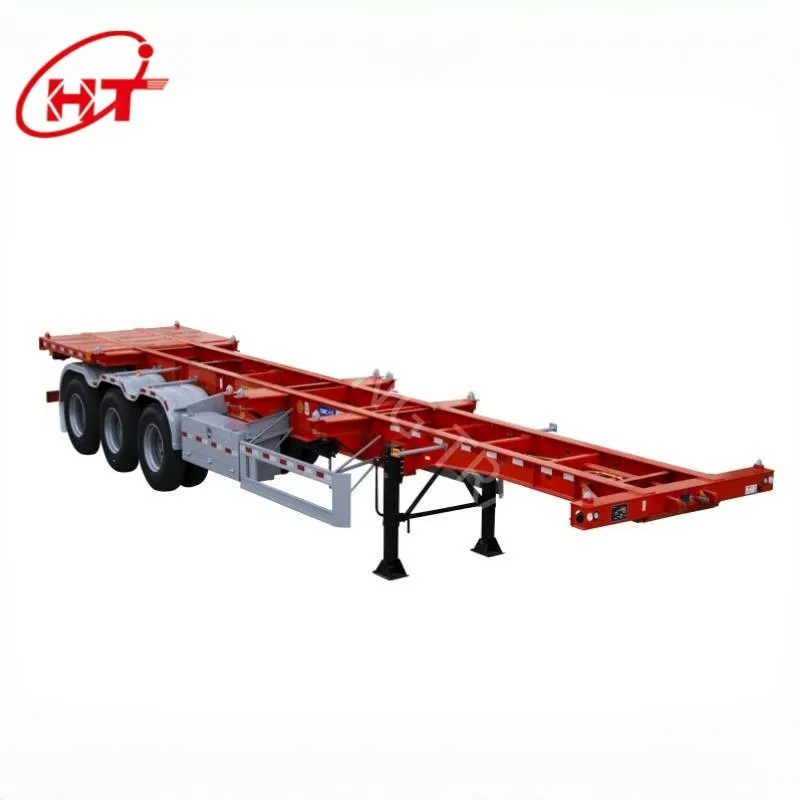
As a cement trailer supplier, we also offer a range of other trailers such as the Skeleton Semi Trailer, Low Bed Tractor Trailer, and 4 Axle Low Bed Trailer. Each of these trailers is designed with vibration reduction in mind, using similar principles and technologies.
If you're in the market for a cement trailer or any of our other trailers, we'd love to talk to you. Whether you're a small - scale business or a large - scale transportation company, we have the right solution for you. Contact us today to start the procurement discussion and find out how our trailers can meet your needs.
References
- "Vehicle Suspension Systems" by Smith, John. Published by Automotive Press.
- "Tire Technology Handbook" edited by Jones, Sarah. Published by Rubber Industry Press.
- "Structural Design for Heavy - Duty Trailers" by Brown, David. Published by Transport Engineering Journal.


